
A viral complication report, a product not intended for injection, and what clients and injectors need to know.
Written by Injector Rick, founder and aesthetic practitioner at BONAVADA Aesthetics in Worthing.
Regenerative aesthetics has discovered another exciting set of initials: PDGF.
It sounds like either a government department or something you should not Google on a work computer. In reality, PDGF stands for platelet-derived growth factor, a protein involved in healing and tissue repair.
PDGF effectively tells certain cells:
“Come over here, multiply and start rebuilding.”
Useful after an injury. Potentially useful after microneedling. Slightly more adventurous when injected directly beneath somebody’s eyes.
What happened in the viral PDGF case?
An Instagram post shows a woman reporting persistent under-eye changes 14 months after a PDGF treatment, with surgery reportedly planned to remove the affected tissue.
The photographs are concerning, but this is a social-media report, not a published medical case. From the post alone, we cannot independently confirm the exact product, dose, injection depth, technique or whether PDGF caused the entire problem.
A before-and-after photograph is not a clinical trial, even when it has excellent lighting and 47 shocked-face emojis underneath it.
However, the case raises a much bigger question.
Was the product actually designed to be injected?
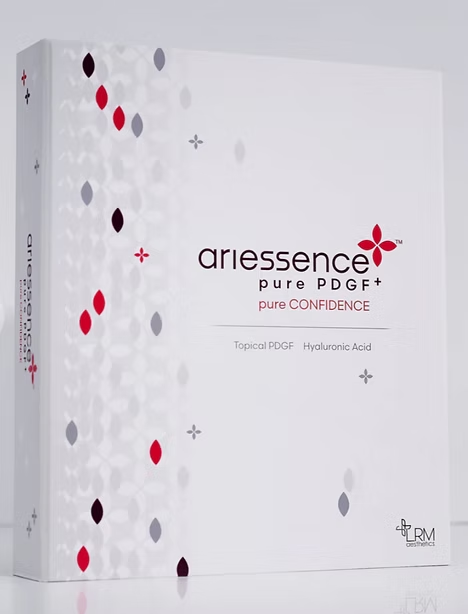
One product at the centre of the current PDGF trend is ariessence pure PDGF+, containing manufactured recombinant PDGF-BB and uncrosslinked hyaluronic acid.
The manufacturer describes ariessence as a topical cosmetic product, typically rubbed onto the skin following procedures such as microneedling. Its website explicitly states that the product is not intended for any other use and that administration by injection is not approved by the FDA.
This distinction matters.
If ariessence was the product used in the reported case, it did not accidentally wander into a syringe and inject itself. The treating injector made a deliberate decision to use a topical product by a route specifically excluded by its manufacturer.
That choice belongs to the injector, not the product and certainly not the client.
Calling something “off-label” does not automatically make it reckless. Many established medical treatments involve responsible off-label use. But there must be credible evidence, appropriate consent, suitable insurance and a realistic plan for managing complications.
“Everyone on Instagram is doing it” is not clinical governance.
Does topical PDGF work?
There is some encouraging research.
A controlled clinical trial found that applying recombinant PDGF topically after radiofrequency microneedling improved short-term skin-quality measurements and patient satisfaction compared with standard aftercare. No serious adverse events were reported during the 30-day study.
That supports topical post-procedure use.
It does not establish a safe under-eye injection dose, depth or technique.
Applying a product after microneedling and depositing it beneath the skin are not interchangeable. Putting moisturiser on toast does not make it butter.
What do we know about injectable PDGF?
Not nearly enough.
A 2026 academic review warned that topical cosmetic PDGF products are now being injected despite the lack of standardised dosing, controlled injection trials and established safety thresholds. The authors concluded that aesthetic PDGF use should currently be considered investigational, rather than routine practice.
A separate study documented 32 women who developed swelling, redness and excessive tissue growth after injections of poorly defined growth-factor solutions. Many required surgery, and recurrence was reported in some cases. This was not a study of ariessence, so it cannot prove that the modern product causes the same complications. It does demonstrate how difficult unwanted growth-factor responses can be to diagnose and treat.
“Regenerative” is a scientific category. It is not a magic word that allows a product to enter the face without showing identification.
What should injectors learn?
Before injecting any growth-factor product, the practitioner should be able to answer:
- Is this exact product manufactured for injection?
- What evidence supports this dose, area and tissue plane?
- Does my insurer cover this specific use?
- What will I do if swelling or tissue growth appears months later?
- Who manages the patient if the product cannot simply be dissolved?
If the complication plan begins with “I’ve never seen that happen”, there is no complication plan.
What should clients ask?
Ask to see the exact product and its manufacturer’s instructions.
Then ask:
“Is this product intended to be injected under my eyes, and what published evidence supports doing that?”
Do not accept “It’s basically PRP” or “It’s similar to polynucleotides.” PDGF is neither. It is a concentrated signalling protein with a different mechanism.
Severe pain, blanching, sudden visual disturbance or rapidly worsening swelling after any facial injection requires urgent medical assessment.
My honest verdict
PDGF is genuinely interesting, and topical use after certain procedures may have value.
The issue is not that the science is ridiculous. The issue is the leap from:
“This may support healing when applied to treated skin”
to:
“Let’s inject it beneath the eyes and assume the biology will behave itself.”
Injectable PDGF may eventually find a legitimate place in aesthetics. At present, the evidence, dosing guidance and complication pathways have not caught up with the enthusiasm.
This is not a treatment currently offered at BONAVADA Aesthetics.
Written by Injector Rick, founder and aesthetic practitioner at BONAVADA Aesthetics in Worthing.
Because your under-eyes should not be the aesthetics industry’s beta-testing department.
References
Aristizabal Torres, M.A., Gold, M.H. and Bruce, A.J. (2026) ‘PDGF in aesthetics: Hype outpacing the evidence?’, Journal of Cosmetic Dermatology, 25(5), e70907. Available at:
https://pmc.ncbi.nlm.nih.gov/articles/PMC13172654
Accessed 3 August 2026
LRM Aesthetics (2026) ariessence pure PDGF+: Frequently asked questions. Available at:
https://ariessence.com/pages/faqs
Accessed 3 August 2026
Lynch, S.E. et al. (2025) ‘Recombinant pure PDGF improves aesthetic results and patient satisfaction following RF microneedling: A prospective, randomized, controlled clinical trial’, Journal of Cosmetic Dermatology, 24(9), e70425. Available at:
https://pubmed.ncbi.nlm.nih.gov/40937942
Accessed 3 August 2026
Xiong, C. et al. (2023) ‘Complications following facial injection of growth factor solution’, Aesthetic Plastic Surgery, 47(2), pp. 612-621. Available at:
https://pubmed.ncbi.nlm.nih.gov/36123508
Accessed 3 August 2026
Sansome, S. et al. (2026) ‘Consensus guidelines for the management of tissue filler-induced vision loss in the United Kingdom’, Aesthetic Surgery Journal, 46(5), pp. 563-568. Available at:
https://pubmed.ncbi.nlm.nih.gov/41490283
Accessed 3 August 2026