
What an online certificate proves, what it does not prove, and why practical competence cannot be downloaded
Written by Injector Rick, established aesthetic practitioner and qualified aesthetics trainer at BONAVADA Aesthetics, formerly Mr Beautox, Worthing
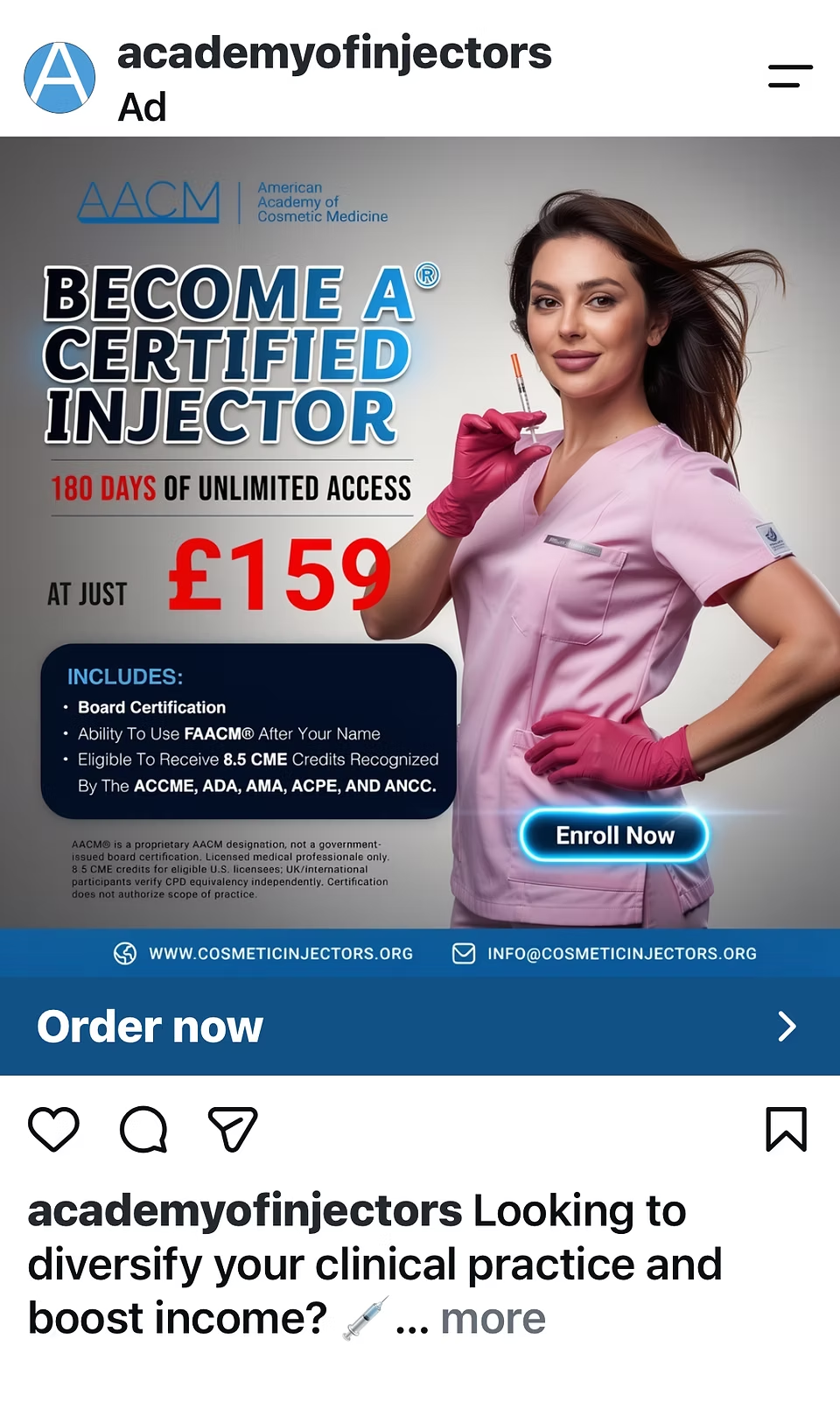
I was scrolling through Instagram when an advert made me stop.
In very large letters, it promised:
BECOME A CERTIFIED INJECTOR
Underneath was an equally noticeable price:
£159
Apparently, 100 days of online access, a certificate and some impressive-looking letters after your name could open the door to a new career in aesthetic injecting.
It sounds almost magical.
Watch some videos. Pass an online test. Add a few initials to your Instagram bio. Find somebody with lips.
What could possibly go wrong?
Quite a lot, potentially.
But the full story is more complicated than the advert first suggests.
What is actually being offered?
The advert came from the American Academy of Cosmetic Medicine, or AACM.
Its website currently advertises an 8.5-hour online neuromodulator and dermal filler course, with access for 180 days, an optional three days of clinical shadowing, a written examination and what it calls “board certification”. Successful learners can use the organisation’s privately owned FAACM® designation after their name.
The current website price is listed as $199 plus tax, although the UK advert I saw promoted the programme for £159.
That sounds substantial until you look more closely at who the programme is for.
The provider states that applicants must already be licensed healthcare professionals, such as registered nurses, nurse practitioners, physician assistants, doctors or dentists. It says it does not accept people without medical credentials.
So this is not quite:
“Anybody can pay £159 and legally begin injecting tomorrow.”
The intended audience already has healthcare education and professional registration.
That is an important distinction.
What does “board certified” mean?
In the UK, phrases such as board certified can sound as though a government regulator or recognised professional body has awarded a formal clinical qualification.
In this case, the certification and the FAACM® letters come from the training organisation itself. FAACM® is a proprietary trademark reserved for its certified graduates.
That does not automatically make the education worthless.
It does mean the credential should not be confused with:
- a UK government licence;
- professional registration;
- an Ofqual-regulated qualification;
- approval to work beyond an existing scope of practice;
- acceptance by a UK insurer;
- or evidence that practical injection competence has been independently assessed.
Ofqual maintains the official Register of Regulated Qualifications in England. Ofqual also makes clear that it does not regulate courses that merely certify attendance without judging a defined level of attainment. A private course certificate and a regulated qualification are therefore not interchangeable (Ofqual, 2026).
Is online aesthetics education a bad idea?
No.
Online education can be excellent for learning or revising:
- anatomy and physiology;
- product theory;
- consultation principles;
- contraindications;
- treatment planning;
- complication theory;
- business processes;
- and professional responsibilities.
For an experienced, appropriately qualified injector, an online programme may provide useful continuing education.
The problem is not the screen.
The problem begins when course marketing allows someone to believe that watching injections on a screen and passing a written examination proves they are competent to inject a real person.
It does not.
What cannot be assessed through a laptop?
Aesthetic injecting is a practical skill.
A trainer needs to observe whether a learner can:
- assess real facial anatomy;
- identify when treatment is unsuitable;
- communicate risks clearly;
- obtain meaningful consent;
- maintain aseptic technique;
- handle a needle or cannula safely;
- control depth, angle, pressure and product placement;
- adapt when real anatomy differs from a diagram;
- recognise an emerging complication;
- and respond safely when something does not go to plan.
A multiple-choice question can test whether you know the definition of a vascular occlusion.
It cannot demonstrate how you respond when a live model develops blanching and increasing pain.
Health Education England’s aesthetics training framework stated that training should be competence-based rather than simply time-based, incorporating theory, assessment and supervised practical experience. It also specified that modality-specific learning should include practical skills training under supervision (Health Education England, 2015).
That is the crucial point.
Knowledge can be taught online. Practical competence must be demonstrated in practice.
Does this mean short courses are bad?
Absolutely not.
I offer one-day and half-day courses myself, so this is not an argument that every worthwhile course must last for weeks.
Course length alone tells you very little about quality.
A short course can be intensive, focused and appropriate when:
- the treatment has a clearly defined scope;
- the learner’s background is checked before enrolment;
- prerequisite knowledge is confirmed;
- theory is completed properly;
- the learner treats live models;
- the trainer provides continuous direct supervision;
- practical competence is individually assessed;
- and the learner is not automatically passed simply for attending.
All my courses are delivered privately on a 1-to-1 basis.
Before accepting a learner, I review their background, existing qualifications, experience and intended insurance route. During training, they receive direct supervision and individual feedback while working with live models.
The certificate is not the starting point.
It is the conclusion reached after the learner has been observed.
A short course can be intensive. It should not be superficial.
A certificate is not the same as competence
A certificate can legitimately show that someone:
- enrolled on a course;
- accessed its content;
- completed required modules;
- or passed the assessment chosen by that provider.
It cannot automatically tell a patient:
- how much practical experience the person has;
- whether they treated a live model;
- whether anyone observed their technique;
- whether they can recognise complications;
- whether their insurance accepts the training;
- or whether the qualification is recognised in the country where they practise.
The NHS advises patients to check a practitioner’s training, experience, insurance, complication knowledge and aftercare arrangements. Its dermal filler guidance specifically cautions against relying on a practitioner who has completed only a short course without sufficient training and experience, because filler complications can include infection, nerve damage and blindness (NHS, 2023).
Again, the issue is not simply that a course was short.
The issue is whether the training produced and assessed genuine competence.
Why overseas certification can be confusing in the UK
England does not yet have one universal licensing and qualification system covering every non-surgical cosmetic practitioner and procedure.
The Government has committed to introducing practitioner and premises licensing, but the detailed rules still require further development and legislation before the full scheme can operate.
The Government’s consultation response recorded repeated concerns about inconsistent training, short programmes, misleading qualification claims and the need for better verification of practitioner competence. It also recognised that professional registration alone does not prove competence in aesthetics, because healthcare professionals still require procedure-specific training (Department of Health and Social Care, 2025).
That regulatory gap makes impressive-sounding overseas credentials particularly easy to misunderstand.
A US certificate may have value within its intended educational context.
It does not automatically answer whether a UK practitioner:
- can legally offer the procedure;
- meets their insurer’s requirements;
- has adequate hands-on experience;
- or is competent to practise independently.
Questions to ask before buying any aesthetics course
Before enrolling, ask:
- Who is eligible, and how are entry requirements checked?
- Is the award a regulated qualification, CPD course or private certificate?
- Does it include supervised treatment of live models?
- Who assesses practical competence?
- Can a learner fail, or is everybody certified after attending?
- Will your intended insurer accept the training?
- What complication training is included?
- What support is available after the course?
- Does the certificate extend your scope of practice in the country where you intend to work?
When the answers are vague, the impressive logo at the top of the certificate becomes much less important.
My honest conclusion
The online course in the advert is not quite the instant injector factory the headline initially suggests.
It is restricted to licensed healthcare professionals and offers optional clinical shadowing. For an existing clinician, the theoretical content may be useful.
However, phrases such as “Become a Certified Injector” and “Board Certification” can create an impression that goes well beyond what an online course can prove, particularly when shown to an international audience.
Online learning can strengthen knowledge.
A written examination can assess understanding.
A certificate can confirm completion.
None of those things, on their own, demonstrates that somebody can safely assess, inject and care for a live patient.
The real qualification is not how impressive the certificate looks. It is whether the practitioner can demonstrate safe, competent practice when a real person is sitting in front of them.
Considering aesthetics training in Worthing?
At BONAVADA Aesthetics Academy in Worthing, training is delivered privately on a 1-to-1 basis, with learner pre-screening, live models, direct supervision and individual practical assessment.
Course suitability and entry requirements are reviewed before booking. Completing the day is not treated as an automatic guarantee of competence.
Contact 07902 245304 or email hello@bonavadaaesthetics.co.uk to discuss current training options.
Written by Injector Rick, established aesthetic practitioner and qualified aesthetics trainer.
Because a sharp needle is not a multiple-choice question.
Instagram advertisement image shown is from the Academy of Injectors promoting online “certified injector” training to a UK audience, captured in July 2026. The screenshot is reproduced for commentary and review. The advertiser’s own small print states that its certification is privately issued and does not extend a participant’s scope of practice.
References
American Academy of Cosmetic Medicine (2026) Online Botox/Neuromodulator and Filler Training. Available at:
Accessed: 30 July 2026.
Department of Health and Social Care (2025) The licensing of non-surgical cosmetic procedures in England: consultation response. GOV.UK. Available at:
Accessed: 30 July 2026.
Health Education England (2015) Qualification requirements for delivery of cosmetic procedures: non-surgical cosmetic interventions and hair restoration surgery. Available at:
https://www.hee.nhs.uk/sites/default/files/documents/HEE%20Cosmetic%20publication%20part%20one.pdf
Accessed: 30 July 2026.
NHS (2023) Choosing who will do your cosmetic procedure. Available at:
Accessed: 30 July 2026.
Office of Qualifications and Examinations Regulation (Ofqual) (2026) Find a regulated qualification. GOV.UK. Available at:
https://www.gov.uk/find-a-regulated-qualification
Accessed: 30 July 2026.
Office of Qualifications and Examinations Regulation (Ofqual) (2026) Apply to have your qualifications regulated. GOV.UK. Available at:
https://www.gov.uk/guidance/apply-to-have-your-qualifications-regulated
Accessed: 30 July 2026.