
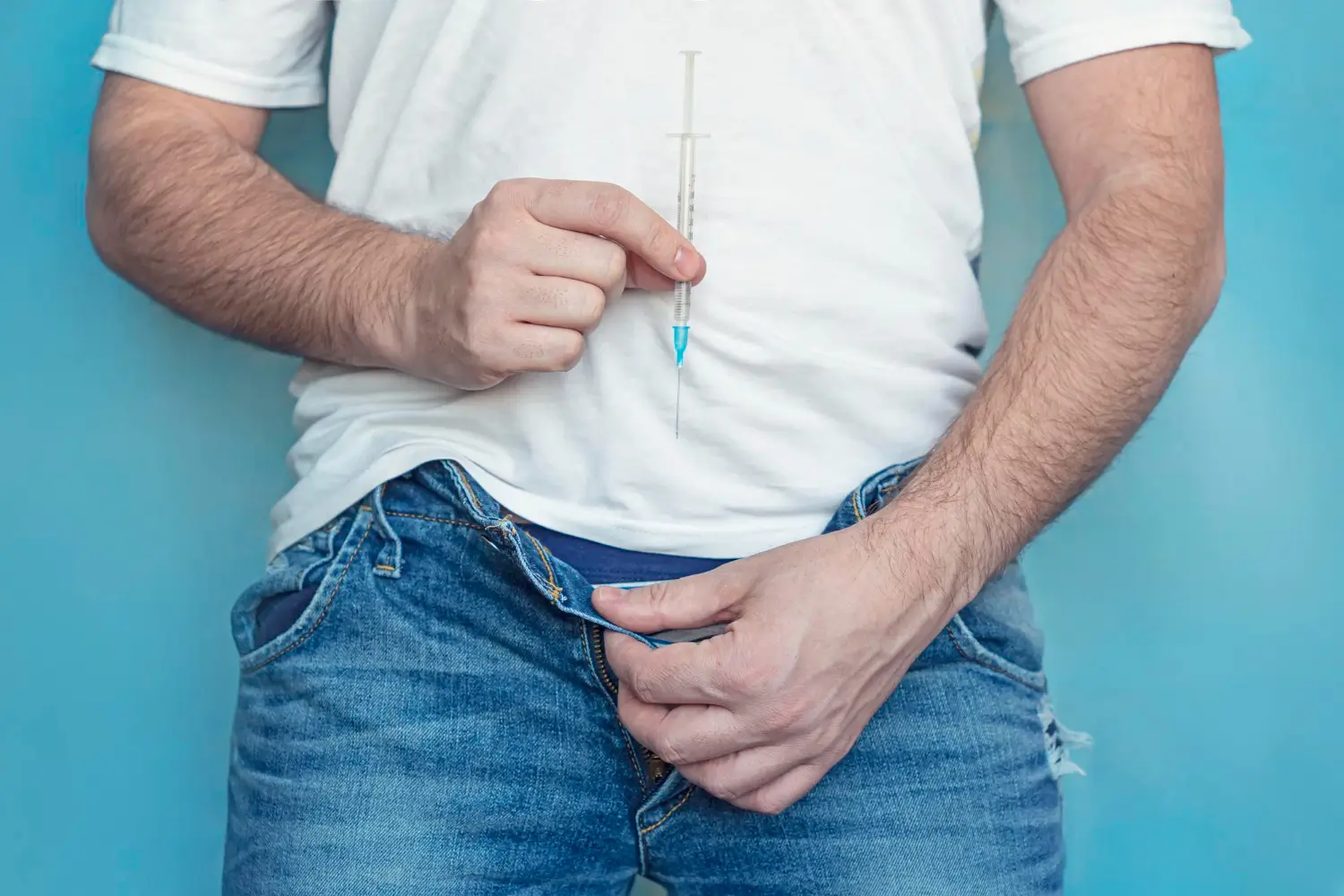
Bigger, thicker, better? The reality of penis filler, the P-Shot and what the clinical evidence actually tells us.
Let’s be honest, penis filler sounds like exactly the sort of thing gay men would pretend not to be interested in while quietly reading every word about it.
It’s one of those treatments that sounds slightly mad, faintly porn-adjacent and very much like something that belongs in a whispered conversation in a bar or a particularly adventurous corner of the internet.
Except it’s real. It’s available. And it’s increasingly being discussed as a way to improve size, appearance and confidence.
On the surface, the appeal is obvious.
Bigger. Thicker. More impressive. More confidence. Sorted.
Except, as with most things involving a needle and a promise, it’s rarely quite that straightforward.
At BONAVADA Aesthetics, I think there’s a much more useful question than simply asking whether penis filler works.
What are you actually hoping to change?
So what exactly does penis filler do?
Penis filler is primarily about increasing girth rather than length.
The procedure generally involves injecting hyaluronic acid (HA) filler beneath the skin of the penile shaft to create additional volume and a fuller appearance, particularly when flaccid.
Studies have demonstrated measurable increases in circumference, with some reporting high patient satisfaction. However, the evidence remains limited, particularly when it comes to longer-term outcomes (EAU, 2026b).
And there’s an important distinction.
Increasing the size of something doesn’t necessarily improve how it functions.
Penis filler isn’t an established treatment for erectile dysfunction, reduced sensitivity or poor circulation.
It’s principally a cosmetic procedure.
That doesn’t make wanting it wrong. It just makes understanding its limitations rather important.
Why are men so interested in it?
Because comparison is a powerful thing.
Comparison in changing rooms. Comparison in relationships. Comparison on dating apps. Comparison with people who, thanks to particularly creative camera angles, apparently have anatomy that defies several laws of physics.
In gay male spaces especially, appearance and body image can become closely intertwined with confidence and sexual desirability.
But body-image pressures are certainly not exclusive to gay men.
For some, penis enlargement is simply about wanting a different appearance. For others, the desire for something bigger may be connected to deeper concerns about attractiveness, sexual performance or self-confidence.
Those motivations aren’t necessarily the same.
Research suggests that while penile enhancement procedures may improve satisfaction with genital appearance, improvements in wider self-confidence and sexual relationships are far less predictable (EAU, 2026b).
A larger penis doesn’t automatically produce a happier man.
And no amount of filler can guarantee that it will.
The bit the glossy adverts tend to gloss over
Penis filler isn’t necessarily a one-off purchase.
Hyaluronic acid is gradually broken down by the body, meaning results are temporary and maintenance treatments may be required.
With some clinics charging thousands of pounds, the longer-term financial commitment is worth considering.
But cost isn’t the only issue.
Possible complications include swelling, bruising, lumps, unevenness, filler migration and infection. Some complications may require corrective treatment, and not every problem is easily reversed (Mubarak et al., 2026).
In fact, a 2026 British Association of Urological Surgeons (BAUS) consensus review examined 36 studies involving 3,748 participants across different genital augmentation procedures.
Its conclusion was that the available research was generally of low quality, with significant limitations when assessing long-term safety and effectiveness (Mubarak et al., 2026).
So before discussing how much filler someone wants, perhaps we should be discussing what happens if the result isn’t quite what they imagined.
Because unlike an unfortunate haircut, waiting for it to grow out isn’t necessarily an option.
What if size isn’t actually the problem?
This is where the conversation becomes more interesting.
When someone asks about penile enhancement, they might mean:
- I want more girth.
- I want a fuller flaccid appearance.
- I want to feel more confident naked.
But they might actually mean:
- My erections aren’t as firm as they used to be.
- I’m worried about sexual performance.
- I’ve noticed changes in sensitivity.
- I want to feel more confident during sex.
And those are very different concerns.
Penis filler may address appearance, but it won’t necessarily address sexual function.
Persistent erectile difficulties can also be associated with underlying conditions, including cardiovascular problems, diabetes, medication effects, hormonal changes and psychological factors (NHS, n.d.).
That’s why a proper medical assessment is important rather than assuming that a cosmetic treatment will somehow solve everything.
So where does the P-Shot come into this?
The P-Shot, sometimes called the Priapus Shot, is a treatment involving platelet-rich plasma (PRP), prepared from a person’s own blood and injected into penile tissue.
It’s often marketed as a regenerative procedure intended to support tissue health or improve aspects of sexual function.
And this is where we need to separate what a treatment is intended to achieve from what research has actually demonstrated.
Some clinical trials have reported improvements in erectile function following PRP injections. Others have found no significant advantage over placebo.
The studies also vary considerably in their preparation methods, doses and treatment protocols.
The European Association of Urology’s 2026 guidelines conclude that the evidence is still insufficient to recommend penile PRP as a routine treatment for erectile dysfunction.
They advise that intracavernosal PRP injections for erectile dysfunction should be used only within clinical trials (EAU, 2026a).
So while the treatment remains an area of scientific interest, it would be misleading to describe the P-Shot as a proven solution for erectile dysfunction, circulation problems or reduced sensitivity.
And being honest about that matters, particularly when people are paying privately for treatment.
Penis filler or the P-Shot: which is better?
Neither is automatically better, because they are not designed to achieve the same thing.
Penis filler has evidence supporting its ability to increase circumference, although outcomes, risks and long-term satisfaction require careful consideration.
The P-Shot is being investigated for possible effects on erectile function, but its clinical effectiveness remains uncertain.
If someone wants a fuller appearance, penile filler may be relevant to that discussion.
If someone wants stronger erections or improved sexual function, the first step should be an appropriate medical assessment, not automatically choosing a PRP treatment.
Established treatments for erectile dysfunction, including medicines such as sildenafil and tadalafil where appropriate, have a stronger evidence base (NHS, n.d.; EAU, 2026a).
Sometimes the most useful treatment discussion is the one that doesn’t begin with a syringe.
And now there’s a regulatory complication
There’s also a significant change potentially coming to the UK aesthetics industry.
On 21 October 2026, the Department of Health and Social Care published draft regulations proposing tighter restrictions on high-risk cosmetic and wellbeing procedures in England.
Under the proposals, cosmetic filler augmentation anywhere outside the face would be classified as cosmetic surgery.
That would include cosmetic penile filler procedures.
If implemented as currently drafted, these procedures would be restricted to doctors working through appropriately CQC-registered providers (DHSC, 2026).
The proposals also include blood-derived cosmetic and wellbeing procedures, such as PRP, among the high-risk non-surgical treatments subject to additional restrictions.
There is an important distinction where procedures are performed to treat a medical condition, as these are outside the scope of the proposed cosmetic and wellbeing restrictions. The regulatory position would therefore depend on the purpose and circumstances of treatment.
The proposals are not yet law, and the public consultation closes on 13 January 2027.
Whatever the final outcome, it reinforces something I’ve argued for some time: advanced intimate procedures require appropriate training, clinical competence, accountability and realistic patient expectations.
What about body dysmorphia?
There’s one final issue that deserves attention.
Not every concern about penis size is evidence of a physical problem.
Some men experience considerable anxiety about their genital appearance despite having measurements within the normal anatomical range.
That doesn’t make the distress any less real.
But it does mean an aesthetic procedure may not be the most appropriate response.
European urological guidance specifically advises against penile filler augmentation in men with penile dysmorphic disorder and recommends careful psychological assessment where appropriate (EAU, 2026b).
A consultation should be about understanding someone’s concerns, not automatically agreeing to change their body.
And sometimes the right answer is to recommend no procedure at all.
Final thoughts
Penis filler gets attention because the promise is simple.
Bigger sounds better.
But bodies, confidence and sexual function are rarely that straightforward.
There is a genuine distinction between wanting to look different and wanting something to work differently.
Penis filler can increase girth, but it carries risks and doesn’t guarantee greater confidence or better sex.
The P-Shot is an interesting area of research, but its benefits for erectile dysfunction are not yet established.
And neither treatment should be presented as the answer to every concern involving the male anatomy.
At BONAVADA Aesthetics, I believe those conversations should be approached openly, respectfully and without embarrassment.
Because sometimes what sounds like a size question is actually a confidence question.
Sometimes it’s a medical question.
And sometimes it’s simply a man who knows exactly what he wants.
The important thing is making sure the treatment actually addresses the question.
After all, there’s no point paying thousands of pounds for a bigger penis if what you really wanted was a better sex life.
Those two things are not necessarily interchangeable.
Written by Injector Rick, founder and aesthetics practitioner at BONAVADA Aesthetics in Worthing.
23 October 2026
This article is intended for general educational purposes and does not replace individual medical advice. The P-Shot is not an established treatment for erectile dysfunction, and any persistent sexual-function concerns should be assessed by an appropriately qualified healthcare professional.
References
Department of Health and Social Care (DHSC) (2026) Restrictions on the performance of high-risk cosmetic and wellbeing procedures in England: consultation document. GOV.UK, 21 October. Available at: https://www.gov.uk/government/consultations/restrictions-on-the-performance-of-high-risk-cosmetic-and-wellbeing-procedures-in-england/restrictions-on-the-performance-of-high-risk-cosmetic-and-wellbeing-procedures-in-england-consultation-document (Accessed: 23 October 2026).
European Association of Urology (EAU) (2026a) EAU Guidelines on Sexual and Reproductive Health: Management of Erectile Dysfunction. Available at: https://uroweb.org/guidelines/sexual-and-reproductive-health/chapter/management-of-erectile-dysfunction (Accessed: 23 October 2026).
European Association of Urology (EAU) (2026b) EAU Guidelines on Sexual and Reproductive Health: Penile Size Abnormalities and Dysmorphophobia. Available at: https://uroweb.org/guidelines/sexual-and-reproductive-health/chapter/penile-size-abnormalities-and-dysmorphophobia (Accessed: 23 October 2026).
Mubarak, M. et al. (2026) ‘British Association of Urological Surgeons (BAUS) consensus document on male genital augmentation and enhancement procedures’, Journal of Clinical Urology, 19(2), pp. 149–166. Available at: https://doi.org/10.1177/20514158251391054 (Accessed: 23 October 2026).
National Health Service (NHS) (n.d.) Erectile dysfunction (impotence). Available at: https://www.nhs.uk/conditions/erection-problems-erectile-dysfunction/ (Accessed: 23 October 2026).