
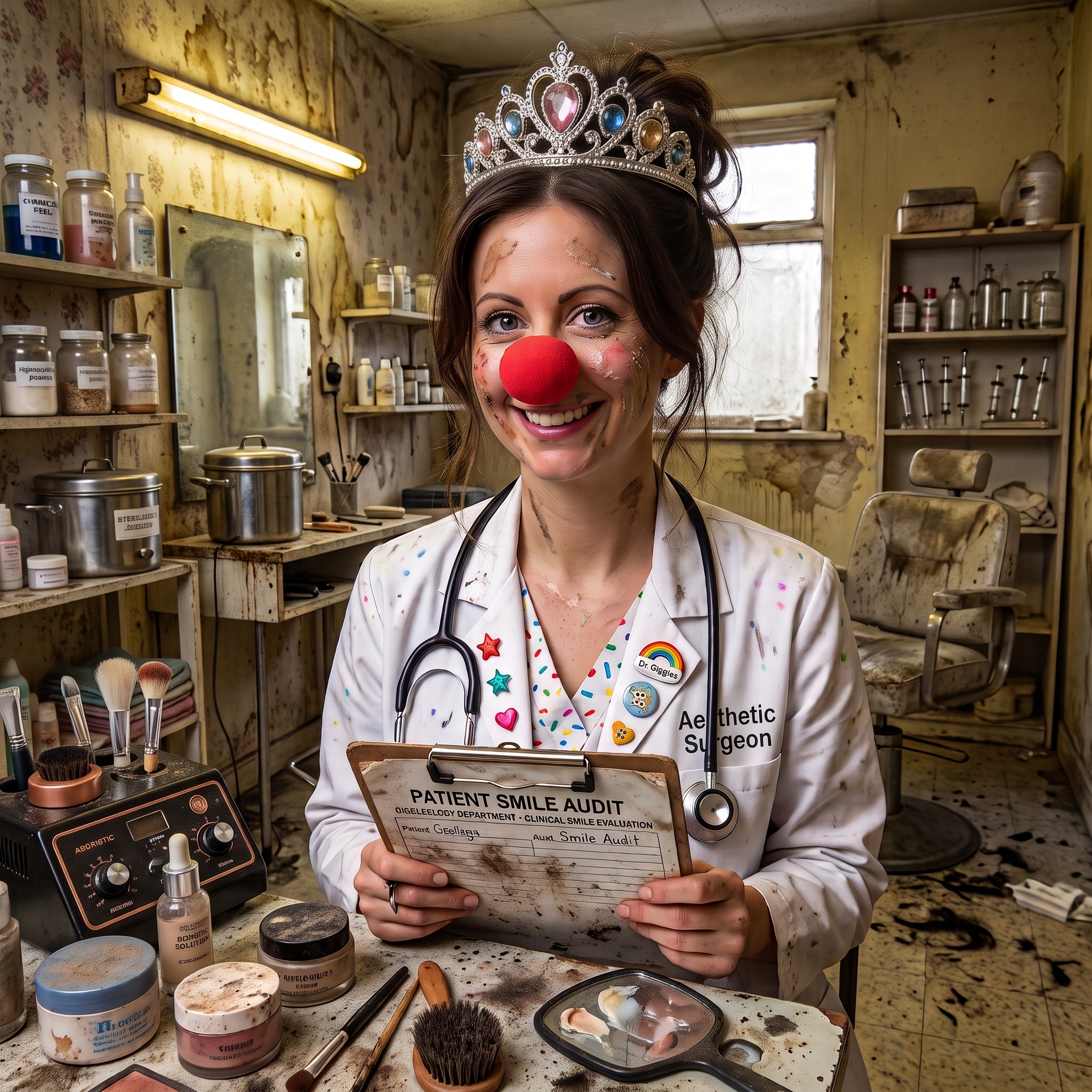
Is your aesthetics practitioner really a Doctor?
When two letters, a pair of scrubs and an Instagram bio start doing rather too much work
Two letters can do a remarkable amount of heavy lifting.
Put “Dr” before a name, add some professional looking scrubs and a framed certificate, and an ordinary clinic bio can begin to resemble a Harley Street consultant’s LinkedIn.
Unfortunately, titles and scrubs are available to anyone with a delivery address.
Important: This article discusses professional titles and advertising claims. It does not accuse every holder of a private credential of wrongdoing, and it is not legal advice.
The quick answer
“Dr” does not automatically mean medical doctor. It can also refer to an academic doctorate or a dental courtesy title.
The problem begins when advertising leads clients to assume medical training that is not there. If somebody advertises injections and lets you add “medical” in your own head, those letters are working overtime.
Doctor of what, exactly?
A medical doctor has trained in medicine. To practise medicine in the UK, doctors need GMC registration and a licence to practise (GMC, n.d.a).
An academic doctor may hold a genuine PhD. A doctorate in medieval tapestry is still a doctorate, but it does not establish medical training or aesthetic competence (CAP, 2026).
A dentist may use “Dr” as a courtesy title, provided their advertising makes their dental status clear (CAP, 2020).
Clients simply need to know which achievement the title represents.
Can you buy a “Doctor of Aesthetic Medicine” credential online?
Astonishingly, Yes.
The European Center for Accreditation currently advertises one for US$1,650.
Its webpage says no prerequisite courses are required, describes it as “direct-to-purchase”, and says the modules and certificate will be emailed within 24 hours of payment.
That is faster than some Amazon deliveries and considerably faster than years at medical school.
The provider also says its credentials do not replace state-sanctioned medical or clinical degrees and prohibits misrepresentation (ECA, n.d.). Even the seller is not claiming that the certificate creates a medical doctor.
A buyer might already be medically qualified. The certificate alone does not prove it. A gold shiny border with a QR code still cannot register its owner with the GMC.
What do the advertising rules say?
CAP advises people without a general medical qualification not to use “Dr” in health-related advertising. A genuine non-medical doctorate must be explained clearly (CAP, 2026).
Clients should not have to play regulatory Cluedo to discover who is holding the needle.
In 2024, the ASA upheld a complaint about the name “Dr Bunny Aesthetics” because it implied medical qualifications for which it received no supporting evidence (ASA, 2024).
That was an advertising ruling, not a criminal conviction. The ASA was judging the impression created by the name, without wigs or a tiny hammer.
Why does it matter?
A client may choose somebody because “Dr” suggests medical training. If that impression is wrong, the decision rests on incorrect information.
This does not mean every non-medical practitioner is unsafe. A medical degree does not automatically prove expertise in aesthetics either. A stethoscope is not a magic wand.
Relevant training, experience, insurance and proper aftercare still matter (NHS, 2023).
Is it actually illegal?
Using “Dr” is not automatically a crime. Section 49 of the Medical Act 1983 does, however, make it an offence to wilfully and falsely pretend to be a registered medical practitioner or use a title implying that status. A dishonest claim used to win paying clients may also amount to fraud (Great Britain, 1983; Great Britain, 2006).
This has led to prison where serious harm followed. In 2018, Ozan Melin, who falsely claimed to be a medically qualified cosmetic surgeon, was jailed for four years after two grievous bodily harm convictions. He injected women with a substance presented as Botox that testing identified as unpurified beef gelatine. One suffered anaphylactic shock and lasting facial damage (Aesthetic Medicine, 2018; Save Face, n.d.).
His prison sentence was for causing serious injury, not simply for putting “Dr” in front of his name. The fake medical status helped create the trust that put those women in his chair in the first place.
What should clients know or ask?
If your injector calls themselves a “Dr”…
- Ask: “Are you a medical doctor, a dentist or an academic doctor?”
- Ask for their registered name and GMC number if they claim to be a medical doctor practising in the UK.
- Check the GMC register. Select “Doctors” and confirm the person’s identity, licence and any restrictions. The GMC also registers physician associates and anaesthesia associates, so “GMC registered” does not always necessarily mean medical doctor (GMC, n.d.b; GMC, n.d.c).
- Use the correct register. Check dentists through the GDC. For a claimed UK degree, check the awarding institution using GOV.UK guidance (GDC, n.d.; GOV.UK, n.d.).
An unsuccessful search is not proof of deception. Names change and circumstances vary, so ask for clarification/spellings before making accusations.
A genuine professional should not react as though you requested their banking password.
What should practitioners learn?
Use the title you earned and explain it. State the subject of a PhD or that you are a dentist. Medical registration can be verified.
If your biography needs smoke, mirrors and three footnotes to explain “Dr”, the title may be doing a job your qualifications cannot.
The same standard applies to me
I am Rick (Richard) Howard-Pay, an aesthetic practitioner and trainer. I am not a medical doctor, and I will not borrow the title or click “buy now” to get one because it looks impressive on my website, social media and booking page.
I hold multiple treatment-specific and model based training certificates covering every treatment I provide, from anti-wrinkle treatments and PRP to advanced dermal filler techniques. My clients are welcome to ask to see them at any time. I also plan to upload them to my website, although the qualifications page may need planning permission for an extension.
I have also completed an AHE Diploma in Health Professionals and hold a Level 3 qualification in Anatomy and Physiology.
I hold a Level 3 Award in Education and Training (RQF). It is a teaching qualification, not a medical qualification.
I am due to begin a BSc (Hons) Adult Nursing degree at the end of September 2026 at the University of Brighton. Beginning it makes me a nursing student. I will only call myself a registered nurse after completing the programme and joining the NMC register (NMC, n.d.).
A university place is exciting. However it is not a time machine.
Frequently asked questions
Does “Dr” always mean medical doctor?
No. It can also mean an academic doctorate or a dental courtesy title. The context should make it clear.
Does a “Doctor of Aesthetic Medicine” certificate make somebody a medical doctor?
No. It does not establish medical training, GMC registration or a licence to practise medicine.
Can somebody with a PhD use “Dr” in an aesthetics clinic?
Potentially, but its non-medical nature must be clear and the advertising must not mislead.
Does being a non-medical practitioner (not a medical Doctor or Nurse/Paramedic) make somebody unsafe?
No. Check their relevant training, experience, insurance, aftercare, public reviews (Google, Trustpilot…) and honesty about their status.
How do I check whether somebody claiming to be a “Dr” is a medical doctor?
Ask for their registered name and GMC number, then check their current entry under “Doctors” on the GMC register.
My honest opinion
This should absolutely not become a turf war. Nobody becomes a brilliant injector by winning qualification Top Trumps.
The issue is honesty.
Be proud of the qualifications you hold. Explain their limits. Do not leave clients to fill the gaps with assumptions, strategic lighting, a filter, a smattering of AI and a flattering set of initials from Temu.
If somebody calls themselves a doctor, “Doctor of what?” is a perfectly reasonable question.
Written by Injector Rick, founder and aesthetic practitioner at BONAVADA Aesthetics in Worthing and Angmering.
The doctorate arrived by email. Unfortunately, the medical training was not attached.
References
Advertising Standards Authority (ASA) (2024) ASA ruling on Dr Bunny Aesthetics. 24 April. Available at: ASA ruling (Accessed: 13 September 2026).
Committee of Advertising Practice (CAP) (2020) Use of the term “Dr”: Dentists. 30 March. Available at: CAP guidance on dental courtesy titles (Accessed: 13 September 2026).
Committee of Advertising Practice (CAP) (2026) Use of the term “Dr”: PhD. 15 July. Available at: CAP guidance on academic doctorates (Accessed: 13 September 2026).
European Center for Accreditation (ECA) (n.d.) Doctor of Aesthetic Medicine (DAM) online degree. Available at: ECA programme and disclaimer (Accessed: 13 September 2026).
General Dental Council (GDC) (n.d.) Search the registers. Available at: GDC register search (Accessed: 13 September 2026).
General Medical Council (GMC) (n.d.a) Unregistered practice. Available at: GMC guidance on medical registration (Accessed: 13 September 2026).
General Medical Council (GMC) (n.d.b) What’s on our registers? Available at: GMC guide to registration records (Accessed: 13 September 2026).
General Medical Council (GMC) (n.d.c) Our registers. Available at: GMC register search (Accessed: 13 September 2026).
GOV.UK (n.d.) Check if your university or college can award a degree. Available at: Degree-recognition guidance (Accessed: 13 September 2026).
NHS (2023) Choosing who will do your cosmetic procedure. Available at: NHS guidance on choosing a practitioner (Accessed: 13 September 2026).
Nursing and Midwifery Council (NMC) (n.d.) Legal basis of registration. Available at: NMC registration requirements (Accessed: 13 September 2026).
Aesthetic Medicine (2018) Bogus doctor convicted over fake ‘Botox’ injections. 5 May. Available at: Aesthetic Medicine (Accessed: 13 September 2026).
Great Britain (1983) Medical Act 1983, c.54, s.49. Available at: Legislation.gov.uk (Accessed: 13 September 2026).
Great Britain (2006) Fraud Act 2006, c.35, s.2. Available at: Legislation.gov.uk (Accessed: 13 September 2026).
Save Face (n.d.) Marcelle King, who fell victim to bogus doctor Ozan Melin, joins Save Face as patient ambassador. Available at: Save Face (Accessed: 13 September 2026).