
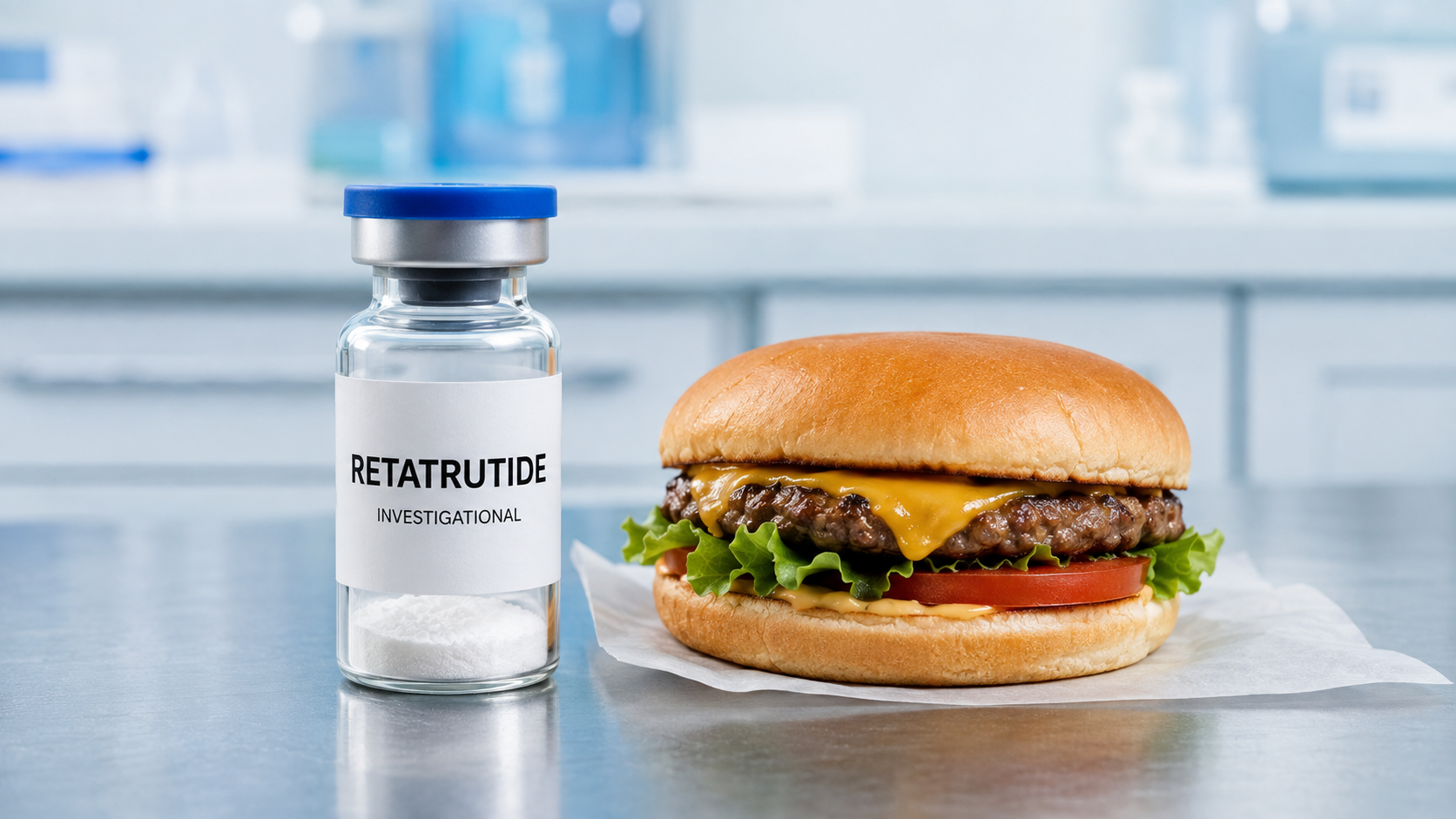
Why hunger can remain, what the trials really found and the rather large problem with anything sold online
Written by Injector Rick at BONAVADA Aesthetics, Worthing
Retatrutide targets three hormone receptors. That sounds as though hunger should be escorted from the building and told never to return.
Human biology is rarely that obedient.
The quick answer
Yes, someone receiving genuine retatrutide in a trial may still feel hungry. Higher studied doses reduced average hunger scores in one phase II analysis, but did not abolish hunger. Hunger alone does not prove treatment failure (Kanu et al., 2025).
However, are you participating in a registered trial? Retatrutide has no UK marketing authorisation, and Lilly states that it cannot legally be sold for human use. The identity, strength and sterility of anything bought online or from a “research peptide” seller cannot be assumed.
Important: This article is provided for education and discussion only. It does not promote, recommend, supply or encourage the use of retatrutide. Retatrutide is not authorised in the UK and BONAVADA Aesthetics does not offer it. Access outside an authorised clinical trial involves an unapproved and potentially unverified product.
What is it?
Retatrutide is a once-weekly investigational injection being developed by Eli Lilly. It activates receptors for GLP-1, GIP and glucagon, rather than the two targeted by tirzepatide.
It is no longer accurate to call the research “early stage”. Several phase III trials have reported positive topline results. However, retatrutide remains investigational, some detailed results are not peer reviewed, regulators have not approved it and Lilly plans to seek US approval in 2027 (Eli Lilly, 2026a).
Promising and available are not synonyms.
How does it work?
GLP-1 and GIP signalling can influence appetite, food intake, insulin release and blood glucose. Glucagon-receptor activation may affect energy use and fat metabolism, but its precise contribution in humans remains uncertain.
Appetite is a mixing desk, not an on-off switch. Retatrutide adjusts several controls, but sleep, stress, habits, food and the body’s response to weight loss remain connected.
What does the evidence actually show?
The most relevant study was an exploratory analysis of 275 adults with type 2 diabetes. At week 24, those receiving 4 mg, 8 mg or 12 mg reported greater hunger reductions than placebo. The 0.5 mg group did not. Higher-dose groups also reported less tendency to overeat (Kanu et al., 2025).
Hunger was self-reported, participants had type 2 diabetes and Lilly funded the study. Satiety scores were not significantly different from placebo. The finding was lower average hunger in selected groups, not the disappearance of appetite.
In the phase II obesity trial, 338 adults lost an average of up to 24.2% at 48 weeks. Weight loss does not establish that every participant stopped feeling hungry (Jastreboff et al., 2023).
Lilly later reported average loss of up to 28.3% at 80 weeks among 2,339 TRIUMPH-1 participants. Impressive topline results are not a substitute for full publication and regulatory assessment (Eli Lilly, 2026b).
So why might hunger remain?
Hunger may vary with dose, individual response and calorie deficit. Weight loss can activate biological signals encouraging eating and regain, although this has not been mapped precisely for retatrutide.
Meals low in protein or fibre, poor sleep, stress, habits and other medicines may matter. Claims that retatrutide routinely “wears off” before the next injection lack good retatrutide-specific evidence.
An unverified vial may contain too little, too much, something else or nothing useful. Hunger cannot diagnose its contents.
What are the risks, limitations or unanswered questions?
In TRIUMPH-1, nausea affected 28.6% to 42.4%, depending on dose. Diarrhoea, constipation and vomiting were common. Dysaesthesia occurred in up to 12.5%, and 11.3% of the 12 mg group discontinued because of adverse events (Eli Lilly, 2026b).
Long-term safety, maintenance after stopping and the final benefit-risk balance require assessment. There is no approved UK dose or patient leaflet.
The MHRA has seized illegally manufactured products labelled retatrutide and warns they lack quality and safety safeguards (MHRA, 2026).
What should clients know or ask?
Trial participants should report persistent hunger and side effects to their team, without changing dose or timing. A brief record of hunger, meals, sleep and symptoms may reveal a pattern.
Outside a trial, do not respond by injecting more. Discuss licensed options with a qualified healthcare professional. Severe abdominal pain, repeated vomiting, dehydration or low-blood-sugar symptoms require prompt advice.
What should practitioners learn?
There is no legitimate UK clinic supply route. Practitioners should not buy, administer, advertise or create waiting lists for retatrutide. A laboratory report does not turn an online peptide into an authorised medicine.
First establish whether a user is enrolled in a registered trial. Otherwise, product uncertainty is the immediate safety issue.
Frequently asked questions
Is it normal to feel hungry on retatrutide?
It can happen. Research shows an average reduction in hunger at higher doses, not elimination of hunger in every participant.
Does hunger mean retatrutide is not working?
Not necessarily. Appetite is only one outcome, and individual responses vary. In a trial, effectiveness should be assessed by the research team.
Does retatrutide wear off before the next injection?
Some online users report this, but robust evidence confirming a predictable end-of-week effect is lacking.
Can I increase the dose if I am hungry?
No. Trial participants must follow their protocol. Products obtained elsewhere should not be treated as genuine or safely adjustable.
Can I get retatrutide in the UK?
Only through an authorised clinical trial. It is not a licensed medicine, and Lilly states that it cannot legally be marketed or sold for human use.
My honest opinion
The evidence suggests retatrutide can reduce hunger, particularly at higher studied doses, but it is not an appetite delete button.
The online market has overtaken the science. Retatrutide is in advanced trials, not ordinary clinical use. If somebody is “on retatrutide” outside a trial, my first question is not why they are hungry. It is what is in the vial.
BONAVADA Aesthetics does not offer or recommend retatrutide. For now, follow the research, use licensed alternatives through legitimate healthcare routes and let regulators finish their job.
Written by Injector Rick, founder and aesthetic practitioner at BONAVADA Aesthetics in Worthing.
Retatrutide targets three receptors. Social media, as usual, targets your wallet.
References
Eli Lilly and Company (2026a) Retatrutide successful in two additional Phase 3 obesity trials, delivering significant improvements in weight and A1C. Eli Lilly and Company.https://investor.lilly.com/news-releases/news-release-details/lillys-triple-agonist-retatrutide-successful-two-additional
Accessed 18 August 2026
Eli Lilly and Company (2026b) Retatrutide delivered powerful weight loss in pivotal Phase 3 obesity trial. Eli Lilly and Company.https://investor.lilly.com/news-releases/news-release-details/lillys-triple-agonist-retatrutide-delivered-powerful-weight-loss
Accessed 18 August 2026
Jastreboff, A.M., Kaplan, L.M., Frías, J.P., Wu, Q., Du, Y., Gurbuz, S., Coskun, T., Haupt, A., Milicevic, Z. and Hartman, M.L. (2023) Triple-Hormone-Receptor Agonist Retatrutide for Obesity: A Phase 2 Trial. New England Journal of Medicine, 389, 514-526.https://doi.org/10.1056/NEJMoa2301972
Accessed 18 August 2026
Kanu, C., Boye, K.S., Poon, J.L., Goetz, I., Williamson, S., Lou, J., Hartman, M.L., Martin, C.K. and Coskun, T. (2025) Appetite, eating attitudes, and eating behaviours during treatment with retatrutide in adults with type 2 diabetes: Results of a phase 2 study. Diabetes, Obesity and Metabolism, 27(12), 6988-6998.https://doi.org/10.1111/dom.70097
Accessed 18 August 2026
Medicines and Healthcare products Regulatory Agency (2026) Two arrested during the MHRA’s largest ever seizure of unlicensed weight loss medicines. GOV.UK.https://www.gov.uk/government/news/two-arrested-during-the-mhras-largest-ever-seizure-of-unlicensed-weight-loss-medicines
Accessed 18 August 2026