
The collagen-stimulating injectable that plays the long game
Written by Injector Rick, founder and aesthetic practitioner at BONAVADA Aesthetics in Worthing.
PLLA is suddenly everywhere, described as a biostimulator, a collagen treatment and, occasionally, something so revolutionary you might expect it to reorganise your kitchen cupboards. The science is interesting enough without the theatrics: PLLA encourages your body to build more of its own collagen.
The quick answer
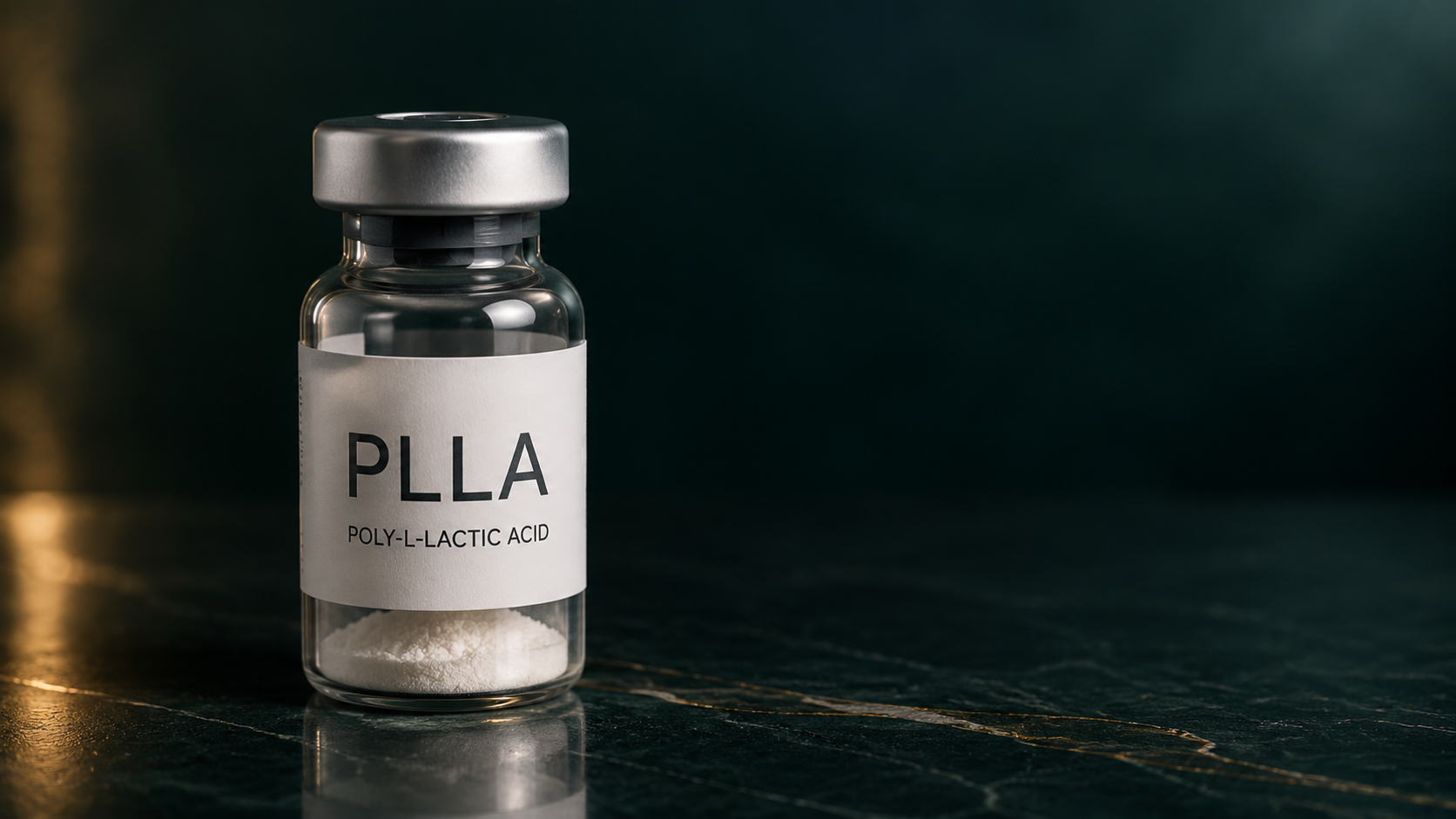
PLLA stands for poly-L-lactic acid. It is a synthetic, biocompatible and biodegradable material injected beneath the skin to stimulate collagen production. It may help restore broader facial volume loss, improve firmness and soften wrinkles over time.
It is not the same as hyaluronic acid filler. Results are gradual, usually require a course of treatment and cannot be instantly dissolved with hyaluronidase. Studies of the best-established product, Sculptra, report improvements lasting up to approximately two years, although results vary (Narins et al., 2010; Fabi et al., 2024).
What is it?
PLLA is a man-made polymer with a long history in medicine, including use in dissolvable sutures. In aesthetics, tiny particles are prepared as an injectable suspension and placed into selected tissue planes.
Sculptra is the best-known PLLA brand, but PLLA is an ingredient, not one universal product. Brands differ, and a Sculptra study does not automatically validate every cheaper vial carrying the letters PLLA.
It may suit general hollowing, reduced facial support or mild laxity caused by ageing or weight loss. It is better suited to gradual, wider-area improvement than instant lip enhancement or precise correction of one small feature.
How does it work?
PLLA particles trigger a controlled foreign-body response. Macrophages gather around them, fibroblasts become involved and new type I and type III collagen is laid down as the particles gradually break down (Stein et al., 2015).
Hyaluronic acid filler arrives carrying the furniture. PLLA hires the builders.
The water used to prepare it can create immediate fullness, but this fades within days. The genuine result develops over weeks and months as collagen forms. Sensible treatment is therefore staged rather than enthusiastically overfilled on day one.
What does the evidence actually show?
A 2024 systematic review included 11 randomised trials. Four reported improvements in dermal thickness, facial volume loss or aesthetic scores lasting at least 25 months. PLLA also performed better than human collagen in two studies (Signori et al., 2024).
A randomised study of 233 people found PLLA produced longer-lasting improvement in nasolabial folds than human collagen, with benefit reported for up to 25 months (Narins et al., 2010). A 40-person placebo-controlled trial found improved elasticity, hydration and other skin-quality measures at 12 months (Bohnert et al., 2019).
However, none of the 11 trials had a low risk of bias and five had a high risk. The overall evidence was judged low quality. There is real clinical research, but the marketing is often more confident than the science.
What are the risks, limitations or unanswered questions?
Common short-term effects include swelling, bruising, redness, tenderness and itching. Papules or nodules can develop beneath the skin, sometimes months later. Delayed inflammatory lumps, infection and vascular occlusion are less common but potentially serious. As with other facial injectables, accidental injection into a blood vessel can cause tissue damage, visual disturbance or blindness (Galderma, 2023).
Unlike hyaluronic acid filler, PLLA cannot be dissolved with hyaluronidase. Poor placement, overcorrection or an unwanted collagen response may therefore be difficult to manage. Product choice, anatomy, dilution, depth and technique genuinely matter.
What should clients know or ask?
Ask which exact product will be used, why it suits your concern, how many sessions may be needed and what the full course will cost. Ask about the product instructions, practitioner training and insurance, and the plan for delayed nodules or a vascular complication.
Ask whether PLLA is genuinely better for your goal than filler, another treatment or doing nothing. No one medically needs an aesthetic injectable.
What should practitioners learn?
Do not choose PLLA by vial price alone or borrow evidence from another brand. Check the instructions, regulatory status, supplier, preparation, injection planes and area-specific evidence. Consent must cover the gradual result, likely course, nodules, vascular risk and lack of an immediate dissolving option.
Frequently asked questions
Is PLLA a dermal filler?
It is often grouped with fillers, but its main effect is collagen stimulation rather than immediate gel-based volume.
When will I see a result from PLLA?
Some change may become visible within several weeks, with improvement developing over several months.
How many PLLA treatments are needed?
It depends on the product, area and volume loss. Sculptra patient information describes up to four sessions, with three being typical.
How long does PLLA last?
Selected studies report improvement for up to 24 or 25 months. That is not a guarantee for every person, product or treatment area.
Can PLLA be dissolved?
No. Hyaluronidase dissolves hyaluronic acid, not PLLA or the collagen response it creates.
My honest opinion
PLLA deserves attention because the mechanism is credible and results can be gradual, subtle and long-lasting. For broader facial deflation without an obvious overnight change, it may be an excellent option.
It is not automatically better than filler, or a casual treatment to try because a vial is inexpensive. It takes patience, planning and confidence in the exact product and practitioner. Interest alone is not enough reason to add it to a clinic menu.
Written by Injector Rick, founder and aesthetic practitioner at BONAVADA Aesthetics in Worthing.
PLLA is less I want it now. PLLA takes time. Your collagen has got the builders in, and apparently they’re waiting on a part.Even collagen enjoys a slow entrance.
References
Bohnert, K., Dorizas, A., Lorenc, P. and Sadick, N.S. (2019) Randomized, Controlled, Multicentered, Double-Blind Investigation of Injectable Poly-L-Lactic Acid for Improving Skin Quality. Dermatologic Surgery, 45(5), 718-724.https://doi.org/10.1097/DSS.0000000000001772
Accessed 18 August 2026
Fabi, S., Hamilton, T., LaTowsky, B., Kazin, R., Marcus, K., Mayoral, F., Joseph, J., Hooper, D. and Shridharani, S. (2024) Effectiveness and Safety of Sculptra Poly-L-Lactic Acid Injectable Implant in the Correction of Cheek Wrinkles. Journal of Drugs in Dermatology, 23(1), 1297-1305.https://doi.org/10.36849/JDD.7729DSS.0000000000001772
Accessed 18 August 2026
Galderma (2023) Sculptra Patient Brochure. Galderma Laboratories.https://www.galderma.com/us/sites/default/files/2023-05/Sculptra_USA_Patient_Brochure.pdf
Accessed 18 August 2026
Narins, R.S., Baumann, L., Brandt, F.S., Fagien, S., Glazer, S., Lowe, N.J., Monheit, G.D., Rendon, M.I., Rohrich, R.J. and Werschler, W.P. (2010) A Randomized Study of the Efficacy and Safety of Injectable Poly-L-Lactic Acid Versus Human-Based Collagen Implant in the Treatment of Nasolabial Fold Wrinkles. Journal of the American Academy of Dermatology, 62(3), 448-462.https://doi.org/10.1016/j.jaad.2009.07.040
Accessed 18 August 2026
Signori, R., Barbosa, A.P., Cezar-dos-Santos, F., Carbone, A.C., Ventura, S., Nobre, B.B.S., Neves, M.L.B.B., Câmara-Souza, M.B., Poluha, R.L. and De la Torre Canales, G. (2024) Efficacy and Safety of Poly-L-Lactic Acid in Facial Aesthetics: A Systematic Review. Polymers, 16(18), 2564.https://doi.org/10.3390/polym16182564
Accessed 18 August 2026
Stein, P., Vitavska, O., Kind, P., Hoppe, W., Wieczorek, H. and Schürer, N.Y. (2015) The Biological Basis for Poly-L-Lactic Acid-Induced Augmentation. Journal of Dermatological Science, 78(1), 26-33.https://doi.org/10.1016/j.jdermsci.2015.01.012
Accessed 18 August 2026